
Participation Is Encouraged. Influence Is Not.
As public trust in institutions frays and policy debates grow increasingly detached from lived reality, a simple Wikipedia article sent by a friend this morning unexpectedly clarified where recovery advocacy now stands. This piece reflects on power, voice and why some organisations remain permanently uncomfortable by design.
It was the Wikipedia page for elite theory. Not exactly beach reading. Not the sort of thing you open expecting pleasure. More the kind of thing you glance at while the kettle boils and then realise you are late for everything because something has started quietly rearranging your thoughts.
The thought came to me I had just come back from a recovery event. A woman stopped me as I was packing up. Her son had completed treatment, done everything asked of him, ticked every box. He was discharged into a city-centre hotel surrounded by dealers.
“They told me it was temporary,” she said. “That was nineteen months ago.”
That, it turns out, is where theory meets life.
Elite theory, put plainly, says this. Power rarely lives where we insist it does. It concentrates. It professionalises. It acquires stationery. It develops a fondness for consultation processes and an almost theological belief in its own neutrality.
There is no smoke-filled room. No grand conspiracy. Just committees, commissioning frameworks, preferred language, and an unshakeable confidence that those closest to power are therefore the most qualified to define reality.
As I read on, I felt that familiar mix of irritation and relief that comes when a theory explains far too much.
Decision-making drifts upward. Accountability trickles down. Systems speak endlessly about inclusion while quietly narrowing who is allowed to decide anything. Lived reality becomes “stakeholder feedback” somewhere around the fourth meeting.
And I kept thinking, well yes. That would explain addiction policy rather neatly.
In the UK, we have built a professional ecosystem that decides what counts as evidence, which outcomes matter, which words may be spoken aloud, and which questions are deemed, at best, unhelpful and, at worst, unsafe.
People with lived experience are invited in, of course. Warmly. They are offered biscuits, thanked for their bravery, and asked to tell their stories. Then they are gently steered away from anything resembling authority.
Participation is encouraged. Influence is not.
This is not because the people involved are wicked. Most are decent. Many are sincere. But structures shape behaviour far more reliably than virtue ever could. Over time, institutions begin defending their assumptions with the loyalty usually reserved for family heirlooms.
A system that congratulates itself while people continue to die is not compassionate. It is sentimental.
A conversation has been unfolding for the last few weeks also among friends who have been instrumental in shaping the UK conversation about recovery in the UK. It has wandered, as good conversations do, from Pirate Bay to Spotify.
Pirate Bay broke the old model. Spotify domesticated it.
Someone asked the question that stuck with me.
If Pirate Bay became Spotify, what’s the next Pirate Bay?
The question wasn’t really about music. It was about movements.
About how radical, human, bottom-up energy keeps getting absorbed, licensed, regulated, tidied up and sold back to the people who created it. Not crushed. That would cause resistance. But translated. Sanitised. Made safe.
Recovery in the UK has followed that same arc.
Which brought us in the wandering whatsapp chat to a harder question. What should the relationship be between a recovery movement and the establishment?
Do we rage at it and burn out? Do we flatter it and get funded? Or do we ignore it entirely and retreat into fellowship?
The answer, we came up with is uncomfortably, is none of the above.
The choice isn’t fighting the system, flattering it or pretending it doesn’t exist.
The real option is building a recovery movement so grounded, relational and morally confident that the system has to reckon with it rather than absorb it.
Independent from, but not detached from.
Independent from control, capture and permission, but not from cooperation, responsibility or scrutiny.
The harder truth is that we barely have a movement at the moment. Much of what gets called “the recovery movement” is heavily astroturfed. Built top-down. Funded first. Values added later. When identity is shaped by commissioning, it stops being a movement and becomes a delivery mechanism.
That’s not malice. It’s gravity.
When money comes first, meaning follows.
By moral confidence, I don’t mean moral superiority. I mean something quieter and much rarer. A community that knows what it believes about human beings before it asks anyone to fund it. One that doesn’t wait for government to define recovery. One that doesn’t soften its language to survive commissioning. One that doesn’t rename maintenance as transformation because a contract requires it.
Moral confidence is the ability to say calmly, this helps people recover, this doesn’t, and no amount of money will make us pretend otherwise.
It is holding hope without guaranteeing outcomes. Refusing both cruelty and surrender.
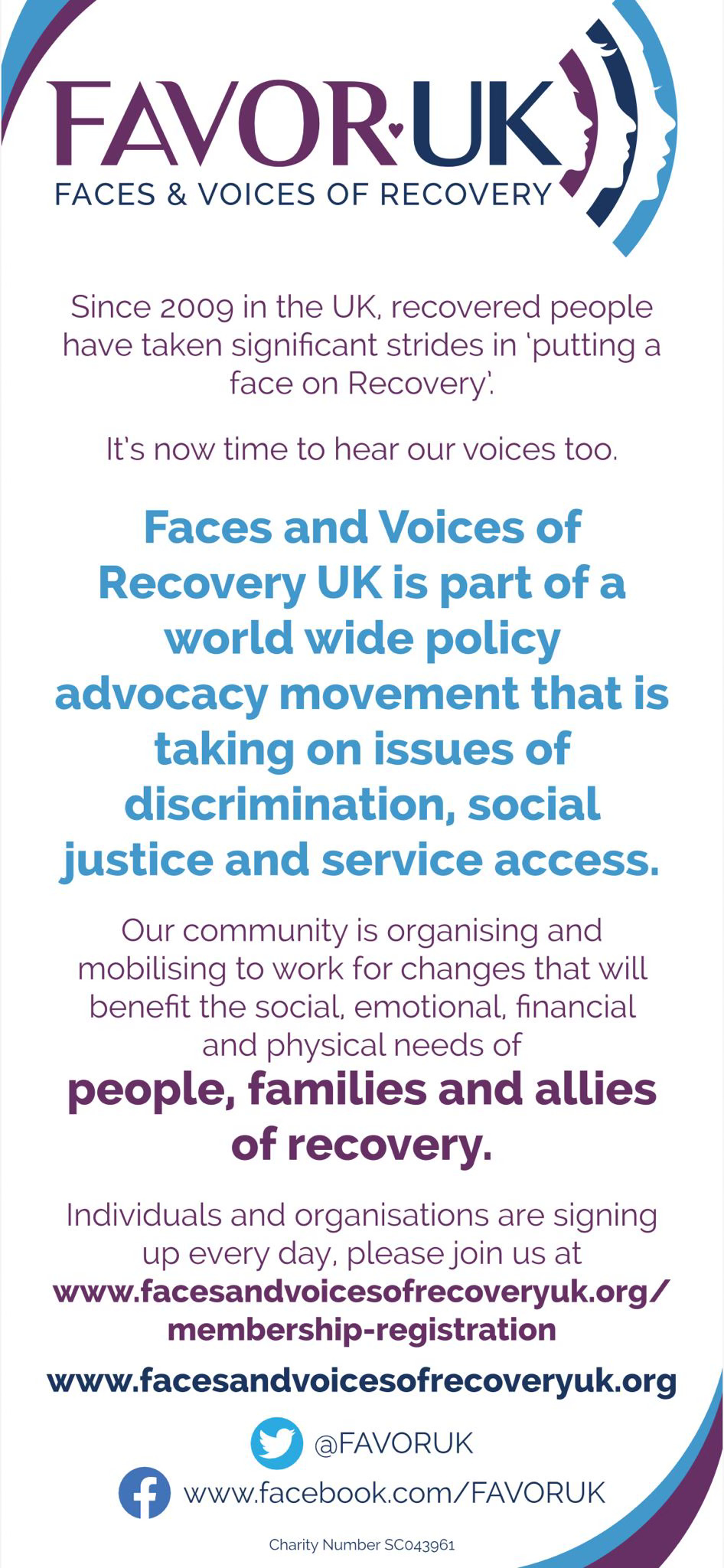
At some point in that discussion, I went back and looked at the original FAVOR UK banners. Not through nostalgia, but curiosity. What did we actually say this movement existed to do?
The opening line reads:
“Since 2009 in the UK, recovered people have taken significant strides in putting a face on recovery. It’s now time to hear our voices too.”
That matters.
This was about visibility and voice. Not service delivery. Not workforce development. Not becoming a subcontractor to the state.
The banner goes on:
“Faces and Voices of Recovery UK is part of a worldwide policy advocacy movement taking on issues of discrimination, social justice and service access.”
Advocacy, not ownership. Influence, not control.
Then this:
“Our community is organising and mobilising to work for changes that will benefit the social, emotional, financial and physical needs of people, families and allies of recovery.”
Not just treatment episodes. Life conditions. Housing. Money. Belonging. Stability. The terrain recovery actually lives on.
The second banner calls FAVOR the home of the UK Recovery Walk and speaks of achieving “a just response to addiction as a public health crisis”.
Not a convenient response.
Not the cheapest response.
A just one.
And finally, simply:
“An addiction charity promoting recovery.”
Not defining it. Not owning it. Not licensing it.
Promoting it.
Suddenly, the Wikipedia page this morning made even more sense.
We were never meant to replace fellowships. Fellowships help individuals recover and wisely stay out of politics. The movement existed to do the civic job fellowships cannot do. To speak publicly. To challenge stigma. To influence policy. To protect access. To define recovery ourselves rather than letting systems redefine it for us.
Which explains why FAVOR UK so often feels inconvenient.
We live in tension.
Between policy and reality.
Between compassion as branding and compassion as outcome.
Between tidy frameworks and messy human lives.
We speak upward without becoming upward-facing only.
We translate lived experience into moral authority without turning trauma into currency.
We refuse both capture and chaos.
Running quietly beneath all of this is a moral tradition older than any policy framework. The dignity of the person. The preferential option for the poor without romanticising poverty. Subsidiarity. Decisions taken as close as possible to those who live with their consequences.
The state has a role, but not a monopoly on meaning.
Markets are tools, not gods. And human beings are not raw material for policy ecosystems.
Once you see it this way, much becomes clearer.
Why recovery is not a service line.
Why dignity cannot be reduced to an outcome measure.
Why people cannot be treated as interventions.
Why we at FAVORUK keep widening the conflict when institutions want to narrow it.
Why we keep saying the quiet bit out loud.
That Wikipedia page didn’t tell us who we should be. It simply helped us remember who we already were.
An organisation rooted in recovery, truth and stubborn moral realism.
The road ahead is not finished. The system will not reform itself overnight. The sea is still rough and the wind unreliable.
But the ship is moving.
And we intend to keep sailing.